

Learn how to make a simple and delicious caramel sauce made with only sugar, milk, and sea salt. No cream or butter needed!
Quick Note: This is an updated version of a post that originally appeared on Bright-Eyed Baker in 2012. Updates include new text and photos, as well as some details added to the instructions for clarity.

Jump to:
Back in the day, when consuming copious amounts of sugar at once didn't seem like an awful idea, my coffee drink of choice was a caramel frappucino. I later moved to a skinny caramel frap, and then to caramel macchiatos, but my love of all things coffee + caramel persisted. It's for that reason and that reason only that I developed this recipe for making caramel sauce with milk.
I tried multiple other recipes - some using a dry method, some a wet method; some with heavy cream, and some with butter. But here's the thing: they were all problematic for one reason or another. One burned. Another was so thick you definitely couldn't pour it into a latté. And every recipe using cream or butter along with the requisite sugar just seemed a little too heavy for an every-morning drink.
So here we are now, after *many* failed batches, with a very simple caramel sauce made without any cream or butter. Making caramel sauce with milk is extremely unconventional, and there's a reason for that: milk has a lot less fat than heavy cream, which makes the process trickier. But it can work, it's still delicious, and after a little practice it's really not difficult at all.
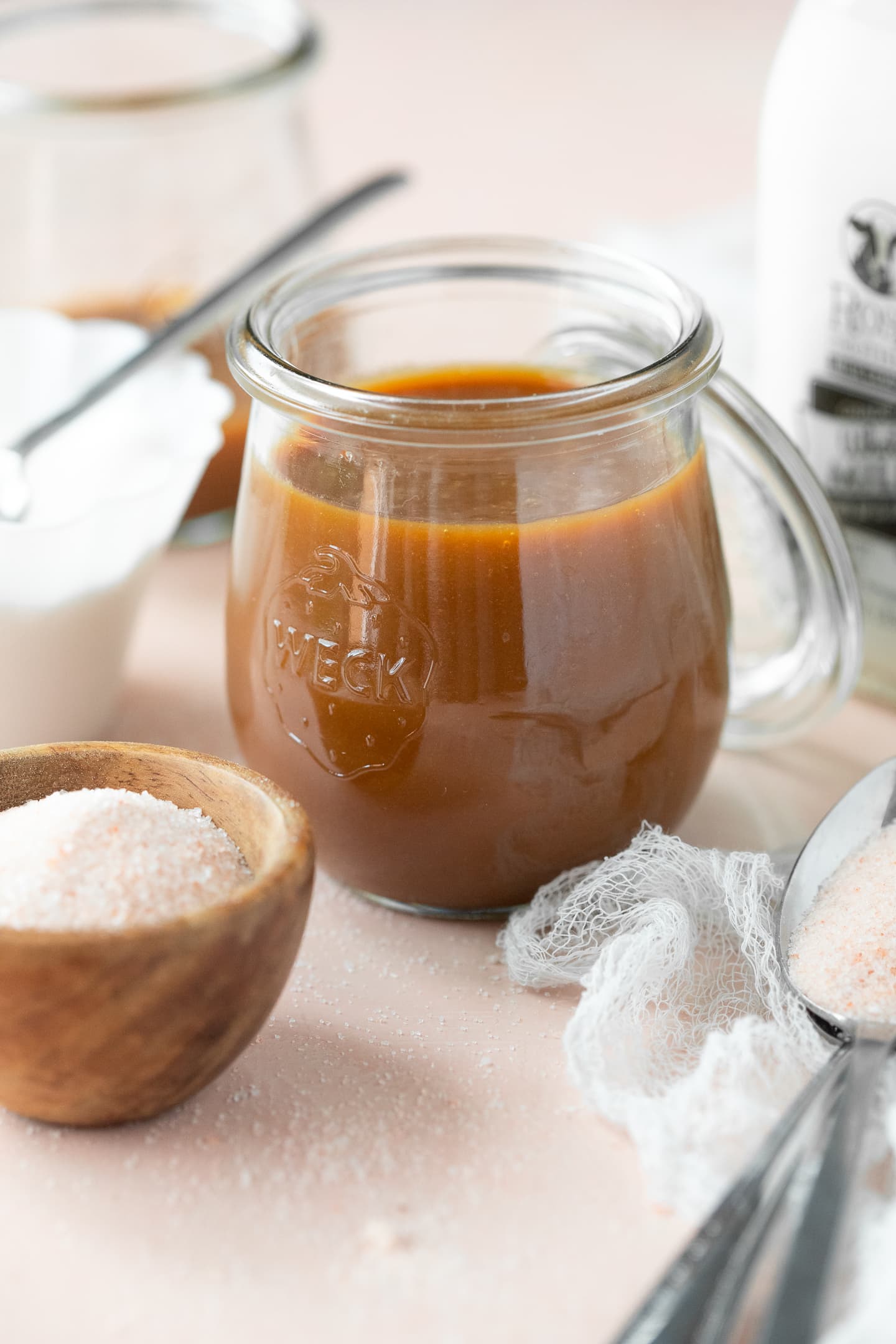
What is dry-method caramel?
Like I mentioned before, there are two basic methods for making caramel: a wet method and a dry method. The wet method involves mixing sugar with water before cooking it; as the sugar melts, the water evaporates. With the dry method, the sugar is heated by itself until it starts to caramelize and turn liquid. Some people find the dry method more difficult, but I personally prefer it.
Ingredients
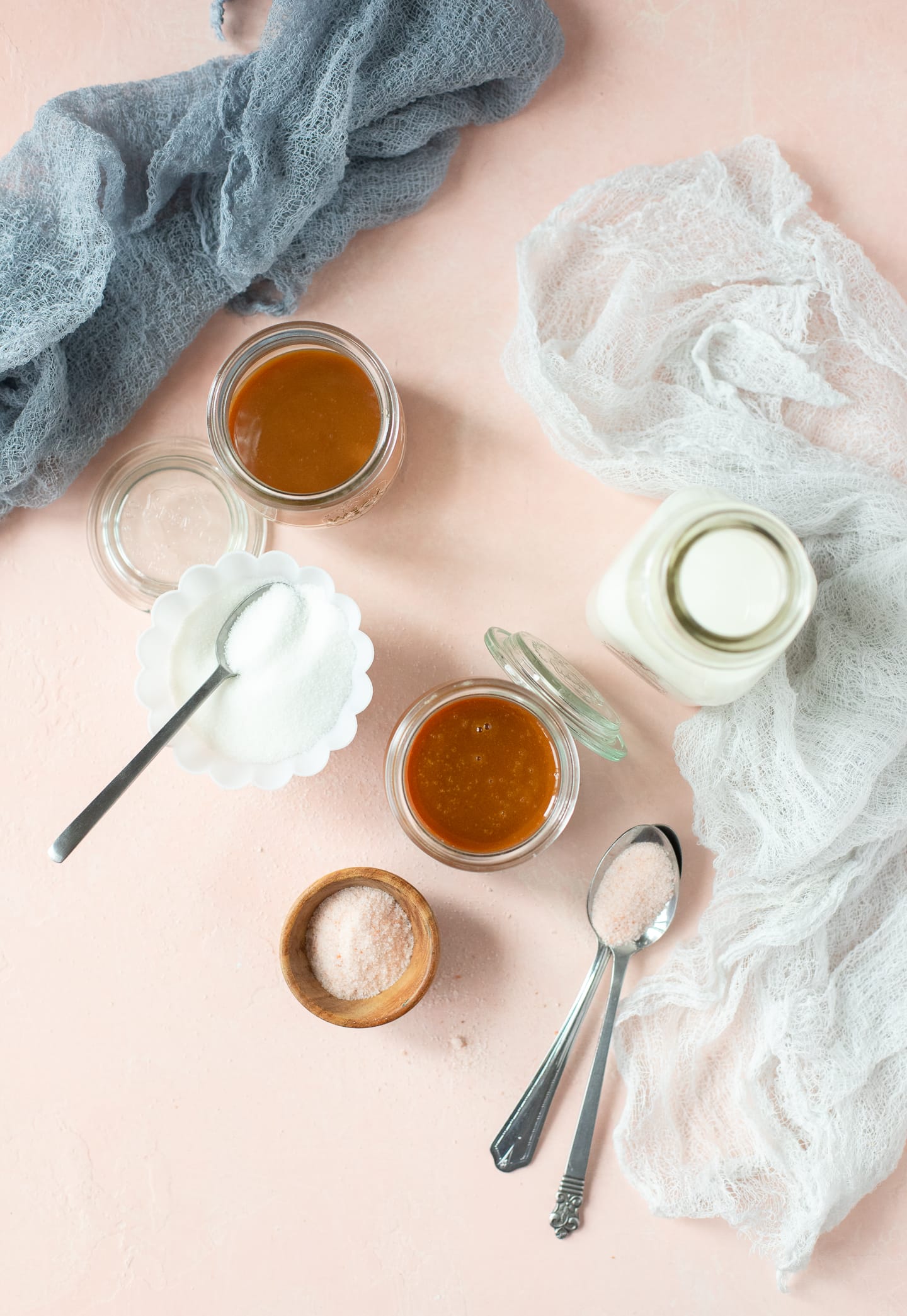
There are only three simple ingredients you need for this recipe: sugar, milk, and sea salt. I've personally tested this recipe with 2% and whole milk, but readers have shared in the comments that they've used all sorts of other milk. See the recipe notes for other types of milk that I've been told work.
Tips for making caramel sauce
This recipe can be tricky until you get the hang of it. Here are some tips I highly recommend you read before starting:
Start with clean tools. Make sure your pot and spatula are clean and dry. Your sugar should also be completely pure; if it has come into contact with bits of flour, etc., that could effect how well it liquifies. Clean conditions help prevent the sugar from crystallizing.
Use a heavy-bottomed, TALL pot. Trust me on this one! A thin pan will lead to burnt caramel, and a pan that's too shallow can lead to a dangerous mess, since the hot caramel will steam and bubble vigorously when you add milk to it.
Wear an oven mitt. Even with a tall pot, I recommend wearing an oven mitt on the hand that you'll use to stir in the milk. You need to keep the caramel stirring constantly once the milk has been added, but the steam can get so hot that this can become close to impossible with a bare hand.
Don't multi-task. Don't try to make caramel at the same time as you're doing something else. The process moves quickly and is extremely time-sensitive. If you're not paying close attention you'll most likely burn your caramel or cause it to seize or curdle, and nobody wants that!
Don't stir the sugar. I can't stress this enough: while the sugar is heating up and starting to liquify, DO NOT STIR. The only thing you want to use your spatula for at this point is to push the liquid sugar on top of the solid sugar so it doesn't burn. Hold off on any stirring until all of the sugar has liquified.
Don't burn the caramel. I realize this seems obvious, but it also needs to be said. Once the sugar turns to liquid, continue to cook it just until it turns a rusty golden-brown color. Then STOP.
Don't give up! Real talk: your first attempt at making caramel might not be a complete success. BUT, I can tell you from my own experience (and that of so many readers who have commented on this recipe!) that the second attempt is usually much better.
For more helpful pointers, check out my top ten tips for making caramel without cream!
Troubleshooting caramel
There are two main issues you might run into while making this caramel sauce:
The milk curdles: One issue with using milk in a caramel sauce is the possibility of it curdling. This can be caused by a few things: the sugar getting too dark or burnt (and acidic) before adding the milk, using old milk, and/or not stirring the caramel constantly once the milk has been added. In any case, you can usually save a curdled caramel sauce by using an immersion blender to smooth it out again.
The caramel seizes: It is not at all uncommon for your caramel sauce to seize when milk is added to it. When this happens, the liquid caramel hardens into a semi-solid clump and you're left with a pot full of milk and a clump of caramelized sugar. Don't panic! Just put the caramel back on the stove and stir it continuously until the clumps melt back into the sauce. It may take a while but it should eventually happen.
Can I double the recipe?
I would highly recommend that you not double this recipe unless you've made it many times already and are 100% comfortable with the process. Too much sugar in a pot becomes hard to cook evenly, and this can lead to all sorts of difficulties.
Making a thicker sauce
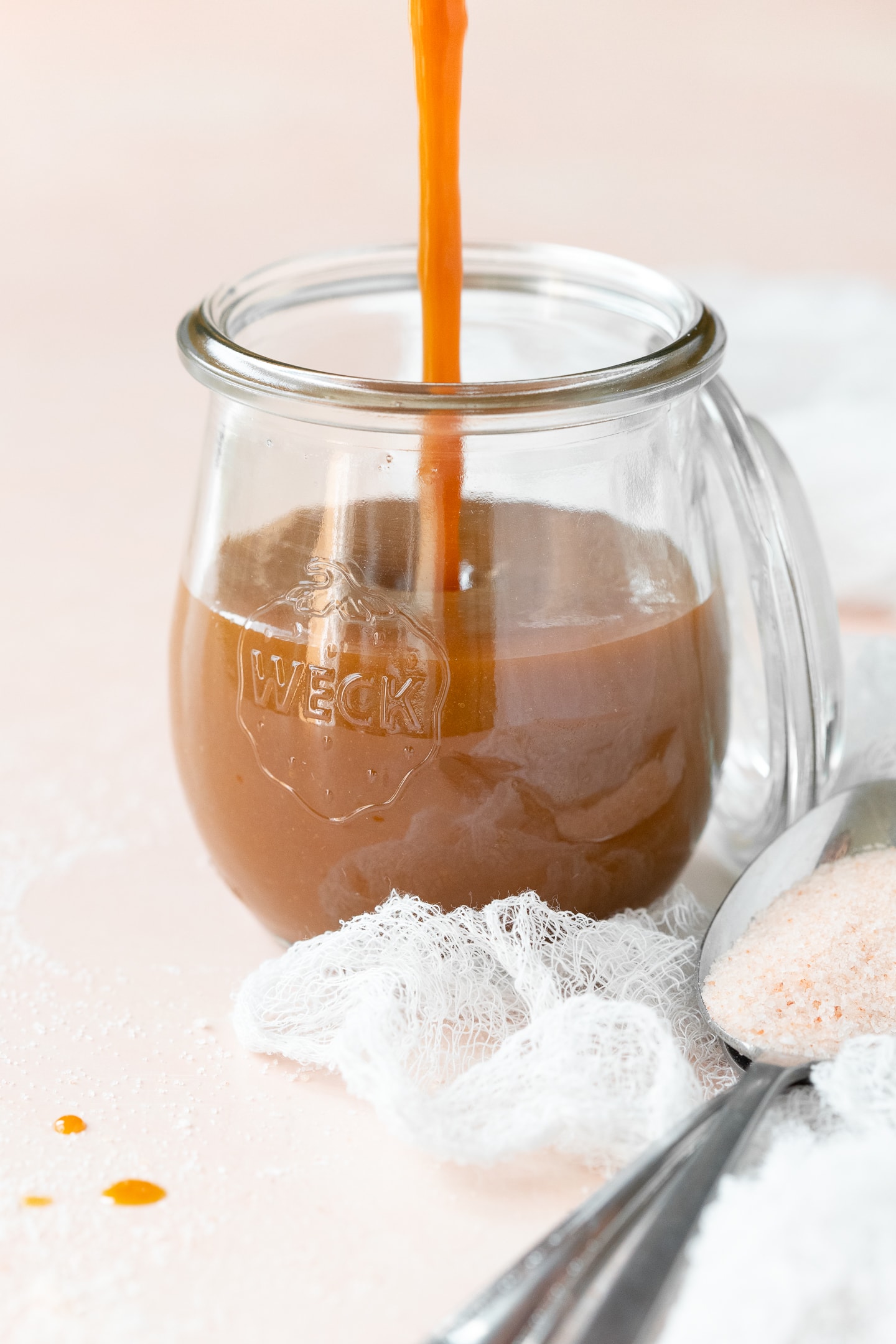
If you don't cook the caramel sauce for more than a couple minutes after adding the milk, it will be thin, which is perfect for mixing into coffee. But if you're looking for a thicker caramel sauce, just cook it longer (about 10-15 minutes after adding the milk) while stirring constantly.
Storing caramel
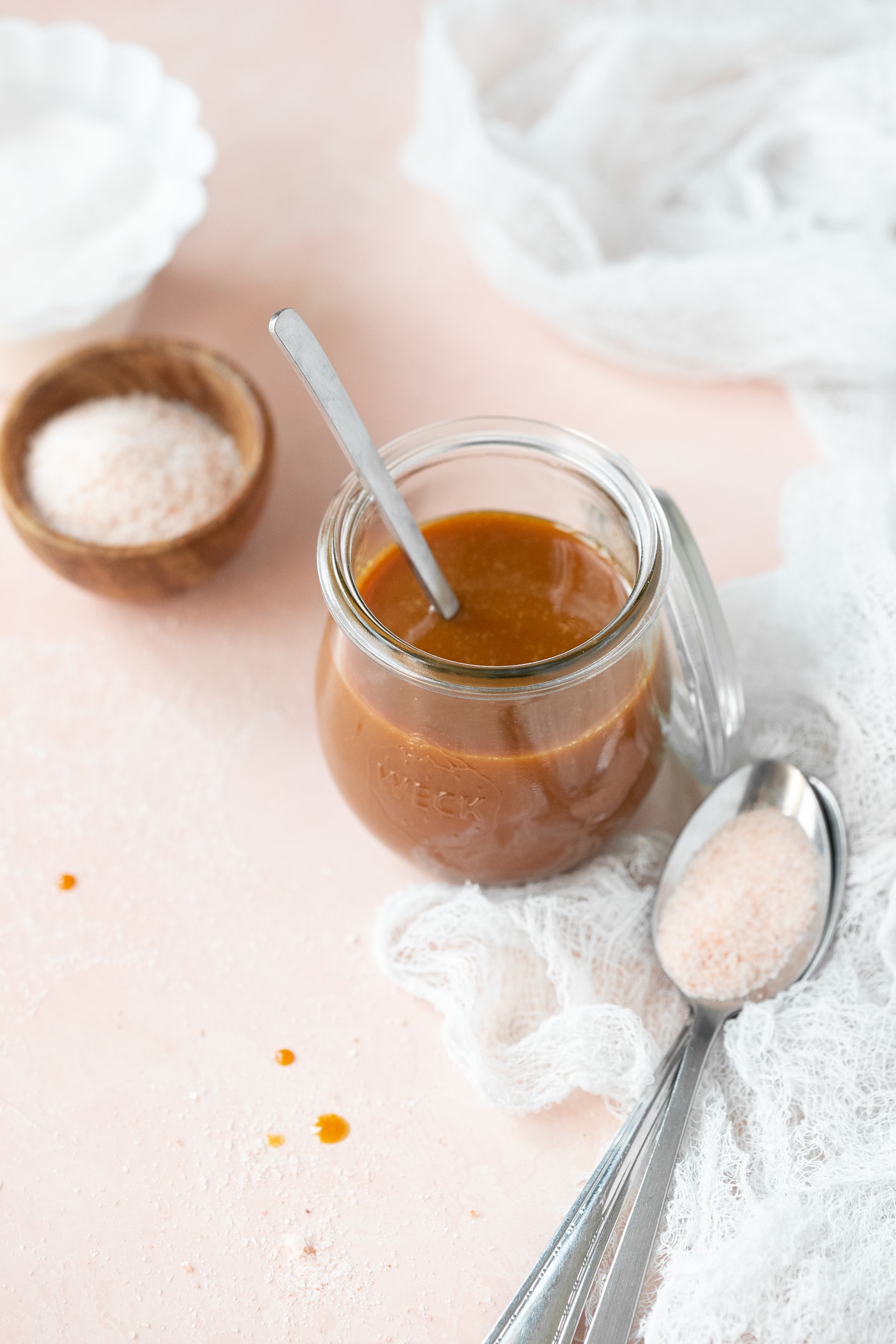
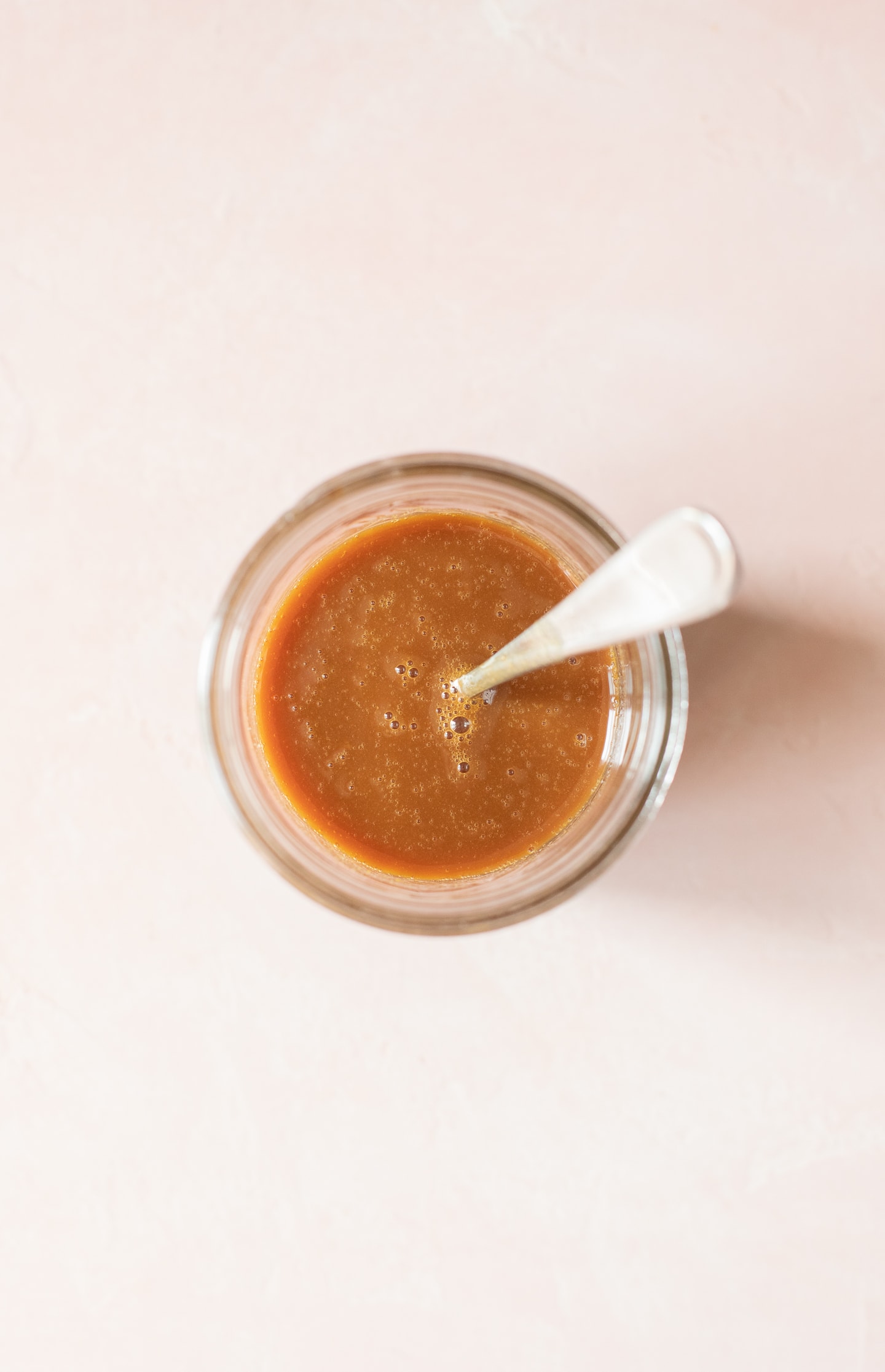
This caramel sauce can be stored in a jar in the refrigerator and should last for several weeks, if not longer. But I have no doubt you'll use it faster than that!
More caramel recipes
Once you've got the hang of making caramel, it's easy to adapt the method to different recipes. Here are some recipes using caramel that you can try:
Caramel Latté Ice Cream - A silky, luscious ice cream that tastes like the frozen version of an ultra-creamy caramel latte. Cannot recommend enough.
Salted Caramel and Candied Pecan Biscotti - Classic biscotti gets an exciting twist with the addition of crunchy candied pecans, a heavy caramel drizzle, and a sprinkle of sea salt to top it all off.
Boozy Chocolate Caramel Cups - Mini chocolate cups filled with rum-spiked caramel. It's homemade candy at its finest!
A final tip
Read through the entire recipe below before you start making this caramel sauce! The process moves very quickly and you'll be much more likely to succeed if you know what to expect.
PrintCaramel Sauce with Milk
A simple and delicious caramel sauce made with only sugar, milk, and sea salt. No cream or butter needed!
- Prep Time: 5 minutes
- Cook Time: 20 minutes (up to 30)
- Total Time: 25 minutes (up to 35)
- Yield: 1 to 1-¼ cups caramel sauce*
- Category: candy
- Method: stovetop
- Cuisine: American
- Diet: Low Fat
Ingredients
- 1 cup granulated sugar
- 1 ¼ cups milk**
- ¼ - ½ teaspoon sea salt***
Instructions
- Heat sugar in saucepan: Place the sugar in a large, tall, heavy-bottomed pot, shaking it so that the sugar is in a thin, even layer. Place the pot over medium-low heat. Set a timer for 8 minutes while the sugar starts to heat up. During this time, leave the sugar untouched.
- Continue cooking: Check on the sugar once the 8 minutes are up. If you're starting to smell it, or see areas where it appears light brown or translucent, it's about to start turning liquid. If this happens, skip to step 3 now. Otherwise, set the timer for another 8 minutes, but this time, keep an eye on the sugar. Around 8 minutes later you should see it starting to liquify.
- Warm milk: Meanwhile, prepare for the next few steps, as they will come quickly. Warm the milk in a microwave-safe container for about a minute, and stir to even out the temperature. Place the warm milk near the stove along with a trivet (where you can quickly place the pot of caramel once ready), and a heat-safe spatula.
- Finish melting sugar: As soon as you see the sugar turning liquid, take your heat-safe spatula and carefully start to scoop the liquid sugar over the solid sugar. Continue to do this as more sugar turns liquid; the idea is not to stir the sugar, but just to keep the liquid parts from burning. Once all of the sugar has turned liquid, stir gently until it turns a rusty golden-brown color. This should only take a few seconds; be careful not to let it burn.
- Add milk to sugar: As soon as the caramel turns the appropriate color, remove it from the stove, place it on the trivet, and quickly stir in half of the warm milk. It's important to keep stirring the caramel during this time. The milk will cause the caramel to steam and bubble rapidly, so be careful as you stir. Continue to stir as the bubbling subsides, and then stir in the remaining milk.
- Return to heat: Some (or much) of the caramel may have hardened when the milk was added. If so, or if you want a thicker caramel, return the pot to the stove. Stir constantly over medium-low heat until any hardened caramel has melted back into the mixture. Be sure to carefully pry any hardened bits off of the bottom or sides of the pot as necessary, melting these pieces back in as well. Be patient; it may seem like they aren't going to melt, but with time it should.
- To make a thicker caramel: If you want a thicker caramel, better for drizzling onto baked goods, cook the caramel, stirring constantly, for an additional 10-15 minutes after adding the milk. Be careful not to let it come to a boil. It will not look very thick while it's hot, but as it cools, it will thicken substantially.
- Add salt and cool: Once all hardened pieces of caramel have melted (as needed) and the caramel has cooked longer (as desired), remove the pot from the heat. Whisk in the sea salt. Pour the caramel into a heat-proof container (if using glass, you can put a metal spoon in it to prevent shattering). Cover and place in the refrigerator to store; it will thicken as it cools.
Notes
*A thinner caramel sauce will yield about 1-¼ cups, while a thicker caramel sauce (cooked longer) will yield about 1 cup.
**I typically use 2% milk or whole milk. Readers have told me that the following will also work: 1%, skim milk, rice milk, goat's milk, almond milk, soy milk, and lactose-free milks such as Lactaid. (I haven't tested these alternatives myself.)
***For more of a "salted caramel", use ½ teaspoon of sea salt. Otherwise, ¼ teaspoon should do it.
Basic Recipe Adapted From: The Perfect Scoop via Annie's Eats



Emma
Hi! I didn't exactly followed your instructions, but I used the same ingredients. Turns out, it worked well! (BTW, it was my first attempt)
thanks for sharing your recipe with us! :)
alexandra
Well I'm glad it worked for you!! You're welcome of course :)
Keliria
Thanks for the post! I almost always have a hankering for caramel and almost never have cream! Tried this just now with relative success; the end result wasn't quite as smooth as it could have been (milk got too hot, sugar may have been too dark also), but I poured it over a pan of brownies anyway. Texture shortfalls aside, this is still a huge success to me because 1) I now have a no-cream caramel recipe, and 2) Any attempt in candy without catastrophic results is a pretty huge win! :)
alexandra
Well I'm glad it went relatively well; for your first time around, that's pretty good! I guarantee you'll get better after a few attempts; I make iced caramel lattes every day, so I literally make this sauce ALL the time. It gets much easier with practice. :)
Crystal
Can i use this for caramel popcorn?
alexandra
I can't say for sure since I've never made caramel corn before... what I can tell you is that the longer you cook the caramel after adding the milk (stirring constantly), the thicker the caramel will be. If you try it out, I would love to hear how it works!
Christy
Third attempt in progress! Here's hoping that third times the charm. I had the first batch on way too high of heat- it started melting after five minutes! I tried to keep going even though it melted early, but I hadn't heated up my milk yet and the whole thing kind of failed. The second time I had much lower heat, but the milk curdled. :( I think I may have gotten the caramel too dark before adding the milk, and I think I had the heat too high when I put it back on the stove. I was trying to get the hard pieces to re-melt, and I got impatient. I'm hoping this third attempt goes well!
alexandra
Good luck! Sounds like you're troubleshooting yourself pretty well. I've only had the curdling issue happen to me once (actually just a few days ago) and I was pretty baffled by why/how it happened. I think I either got it too dark or I may have had something in my measuring glass that threw the whole thing off since I has only rinsed it from a previous use. Hope your next batch works out! And by the way, if you only have a few small pieces of hardened sugar left after you add the milk, sometimes you can just let the pot sit (off the stove) and the residual heat will make it melt after a while. :)
bree
well after two fails, third time was the charm! it finally turned out, and boy was it yummy! i put it on vanilla ice cream with sea salt on top. delicious!
alexandra
So glad that you preserved! The combination of caramel sauce, vanilla ice cream, and sea salt sounds TO DIE FOR!
Kevin
Delicious. They do not carry my favorite coffee creamer anymore, Salted Caramel, but this taste exactly like it so I am very happy with this recipe. Thank You.
alexandra
You're welcome! I'm so glad the caramel lived up to your expectations!
Sara
Hi I tried this recipe and it mostly worked but there were a few things I had trouble with. After I adde the milk, the caramel hardened and I put it back on the heat and it eventually melted like you said it would, but the finished product was too thick and when I put it into the fridge, it became solid. I warmed it back up and put in more milk to thin it, which worked, but it's still too hard to pour after being in the fridge. Is it still too thick because when it's warm it's the right consistency... And btw thanks for the wonderful recipe
alexandra
How long did you have it back on the stove after you added the milk? If you kept it on there for a long time, that might have caused it to get really thick. Maybe next time you could try lowering the heat a bit after you add the milk. Also, just check to make sure your proportion of sugar to milk matches the recipe. My caramel is very fluid even after being in the fridge.
Please let me know if you have any more questions! I'm glad you liked the caramel even if you hit that little roadblock, and I'm sure practice will make perfect with this!
Tiffanie
Have never made caramel before so this was my first attempt and so far it's been a success. Once the sugar was melted, not completely watery but runny (I was afraid to burn it), I took it off the heat and added half of the warm milk and it immediately turned to a rock. I initially started to panic but remembered your suggestion and returned it to the heat. After about 10 minutes it did finally melt but I left it on the heat a bit longer in hopes to thicken it a bit as I plan to use it for dipping apples. It's in the fridge now in 4oz jars cooling. Will let you know how the end result turns out.
alexandra
Sounds like you did pretty well, especially for a first attempt! I'm hoping you kept stirring while you had it on the heat... that is CRUCIAL, but if it looked fine going in the fridge, all should be well. I would love to hear if the apple-dipping works out for you. I would think you'd need some pretty thick caramel for that!
By the way, do make sure that when you melt the sugar, you don't have any sugar crystals still visible. It should all turn to liquid before you have to worry about burning it; I get mine pretty dark rust-y colored since I like to take it all the way to the edge, so don't be too timid. :) That being said, you'll definitely get better and less "shy" with practice at this method!
Tiffanie
Yes, I did continuously stir the caramel while continuing to heat it after adding the milk. The caramel is a dark walnut color and extremely thick, perfect for dipping apples. I will be making several more batched tomorrow as its for teacher appreciation gifts for my children's teachers.
melanie
Tried this three times and followed the instructions to the letter every time (including the troubleshooting suggestions in the comments), but always ended up with a curdled mess. Well done to those of you who can make it work but I'll just have to stick with tradition.
alexandra
I'm sorry to hear the caramel didn't work out for you. I've never had the curdled problem myself, so it sort of baffles me when people do. Did you happen to read this from a previous comment I replied to?
"Firstly, are you using regular granulated white cane sugar? That’s what you should use for this recipe, as a different type of sugar could cause a variety of problems. Secondly, if you got the caramel too dark (and therefore too acidic) before adding the milk, this could have caused the milk to curdle. Lastly, if your milk was getting old, it would have been more likely to curdle."
If so, and if you were stirring constantly when you returned the caramel to the stove, I'm really not sure what else to tell you.
sarah
this is the ONLY caramel sauce i will ever use. it is downright amazing and EASY. thank you so much for the wonderful recipe!
alexandra
Wow, thanks so much for the amazing comment! I'm so glad you like the caramel sauce! :)
Kristian Amber
I just trief this out it turned out great good to know it works with rice milk too
now dialysis patiants like myself can enjoy can enjoy caramel sauce without worrying about the high phosphous content in heavy cream
alexandra
That's great to here! Thanks so much for letting me know about your success with the recipe. I haven't tried rice milk, but I think it's awesome that it works here!
stacey
Mine curdled too :(
Used hot milk but it still split. Definintely curdled, not crystallised sugar. Very bummed, I need a caramel sauce for tonight but don't have any cream and was avoiding dragging the kids out in the rain, but looks like I'll have to, cos now I'm out of milk too!
alexandra
Hi Stacey,
I'm sorry that you had trouble with the caramel sauce! However, I've come up with a few things that may explain why your milk curdled. Firstly, are you using regular granulated white cane sugar? That's what you should use for this recipe, as a different type of sugar could cause a variety of problems. Secondly, if you got the caramel too dark (and therefore too acidic) before adding the milk, this could have caused the milk to curdle. Lastly, if your milk was getting old, it would have been more likely to curdle. Hope these tips help and you give the caramel another try!
Ellen
Hi - I tried this recipe twice yesterday, and both times they failed. Both times, it was fine dissolving the sugar, but when I took it off the stove to add the milk, I was continuously stirring, as you said, but once I'd added the milk and it had stopped bubbling, I noticed small bits floating on top. I scooped some out and it wasnt hardened sugar, it was soft, probably curdled, milk. The milk was hot when added, so I'm stuck about where I went wrong! I tried just heating it up more afterwards, but the lumps still stayed there. I'm determined to find out because so many people are getting great results!!
alexandra
Hmm.. Is it possible that you heated the milk too much and it was curdled before you added it to the sugar? Perhaps your microwave runs hot...
I've never experienced what you described or heard of anyone experiencing that, so that's the only thing I can think of. Also make sure you keep stirring once you put it back on the stove.
Lina
This recipe is awesome!!!! I'm 15 completely clumsy and managed to make this on the first go!!!
alexandra
That's AWESOME! I'm so glad you told me... made my day! :)
Julie
Thank you so much for your post. I was actually trying to make caramel from one of the youtube recipes (with cream, etc) and thought mine had failed (& now what do I do with this failed caramel - usually you don't have to throw things out - you just have to figure out how you can still use them!). So I googled failed homemade caramel sauce & got your site, and due to your encouragement to not freak out if the caramel's hardened, I therefore didn't, kept stirring & sure enough I have a caramel that'll work for that cheesecake I made for Easter dinner at my brother's house after all! Yum! I'll have to read your recipe & try it next time, if it's just as good using milk instead of cream (I'm not too concerned about the cream - we have raw cream from our raw milk (except I did use store bought this time, as I didn't think to save the cream for the caramel)).
Anyway, thank you thank you for addressing the "failures" so they need not be failures!
alexandra
Well, I must say that I never expected to help someone with a different caramel recipe through this post, but I'm so glad I did! Kitchen failures kinda stink, and I'm always one to do a lot of research when I experience one so I can rectify my problem. Great to know that this time I was able to help someone else!
There are a lot of variations on caramel sauce out there and since I don't know what recipe you were using, it's hard to say how this recipe would compare, but this caramel sauce made with milk has been a big hit at my house and I've heard from a lot of other readers who have tried it and loved it. I would say, give it a try if you're feeling experimental! (And don't be worried about a big hunk of hardened caramel in the process). ;)